
Dementia: A Chronicle
A retelling based on personal experience


In their late 70s my parents moved from a moderately sized Midwest town to a rural area where they built a house tailored to their individual interests: quilting for her and woodworking for him. It was far enough away that my sister and I did not visit very often. Mom and dad would visit us occasionally, though my sister was much closer and thus saw them more often.
For several years all seemed to be well. Dad had accumulated a bevy of buddies to have coffee with each day, and mom gifted family members with some of the many quilts she made. Her skills made these heirlooms to be kept and cherished for years.
The first sign of trouble was when Mom sent a quilt at the birth of our second grandchild. Unlike her previous gift for the first child of our middle son, this one was a bit disturbing. Instead of her meticulous hand stitching, some areas were not stitched at all. The fabrics were mostly cotton, but one area was made with drapery fabric, radically different from the rest. My wife, also a quilter, stitched the places that were coming apart. Our daughter-in-law still treasured the love that went into it, and kept it for her daughter.
At the time we just dismissed this as normal aging. Because of the infrequency of contact, we didn’t know much of what was going on.
On one of our visits Dad introduced me to one of his friends. The man’s wife had dementia and was in a memory care unit. This was very hard on his friend, and I could see the prospect worried my father. During the visit he said he felt that he would need more support in the future, and proposed moving to the city where we live, some 1,500 miles away. Being in a suburb of a very large metropolitan area, we had better medical care, and we could help them.

Moving day was a nightmare. They paid the moving company to pack and move them, but the delivery was done by the van driver and a single helper he’d picked up on the way. Their new home was about a third the size of the home they built, and it took a full day for 8 family members, in addition to the mover and his helper, to get it all unloaded.
We attempted to unpack while unloading. At one point Mom handed one of my daughters-in-law a jar of peanut butter that she thought the grandkids would like. It had expired more than 30 years earlier. Numerous other packages were out of date, and there were many little remnants of pasta and other food that should never have been saved. Saving stuff like this is not unusual for someone who survived the Great Depression of the 1930s, but it was also a sign that something wasn’t right.

My father had a steadfast conviction that every medical problem could be solved with the right pill. Both he and my mother had been on medication for hypothyroidism (low thyroid) for most of their adult lives. After the move he could see that Mom was slipping, and he was certain that the problem was due to not having the right dosage of thyroid medication.
Finding an endocrinologist that would accept Medicare was quite difficult, but we did manage. After several visits and dosage adjustments it was clear thyroid was not the problem. During this time Mom had put a plastic pan in her gas oven, which melted it. She also put a metal pan in the microwave, which burned it out. Dad started doing most of the cooking.
At this point I realized Mom needed a neurologist. On the initial visit the doctor had Mom draw a clock, with the hands pointing to 11:10. This is a routine test that my wife and I both get at our annual Medicare exams. Mom managed to get a circle for the face, but when she wrote in the numbers they were all clustered together on the right side. She had no idea where to put the hands. An MRI was ordered.
The MRI revealed many tiny points of light, like stars in a night sky. Each of those was from a Transient Ischemic Attack (TIA), a kind of mini-stroke. This was enough to merit a diagnosis of dementia, and probable Alzheimer's disease. The neurologist prescribed some drugs, but was clear that they were not cures. She also recommended specialized visits to an adult day care facility.
I took Mom to her first day care visit. The people at the facility were very caring and treated her very well. But. when I picked her up later in the day, she was very upset. She had been in the library area, reading and knitting. Every few minutes a man would come into the room, take a book off the shelf, tear out a page, fold it and put it in his pocket. Mom asked a staff member about this. It seems that this was standard behavior for this man, and they were constantly having to replace books. I think this glimpse into her own future terrified Mom. She didn’t go back.
A few days later Dad decided to attend his neighborhood HOA meeting. He’d never had a home with an HOA before, and I think he overestimated the need to attend. I was asked to come and stay with Mom.
We had a very nice conversation about family. At one point she asked me if there were people in the kitchen. I could see from where we sat that it was empty. I got up, turned on the light, and walked around to show it was just the two of us. Then we resumed our conversation. This entire conversation, including the people in the kitchen, was repeated two more times, almost word for word.
Prescription drugs did nothing to help Mom, but did create horrific side effects. Follow-up visits to the neurologist resulted in the recommendation to move Mom to assisted living. We found a place that looked promising, where both of them could live. The staff suggested an overnight stay as a trial.
The next day I drove to their house to help Dad with packing. I was surprised to see both of them getting out of the car. Dad was adamant that they couldn’t stay at that facility. He was certain they could stay at home, and maybe get someone to come in once in a while to help.
I have been married more than 50 years, so I understand why he felt this way. Even so, it was clear that Mom needed a lot more care than Dad was able to give. That day he and I had a heated argument, with me insisting that she needed to be in care. Mom started crying, because she still had enough of her faculties to know that her problem was the source of the argument. It still hurts me to recall that day.

Dad then decided that they needed to go to a place he found in the Midwest. They would have a small cottage on the grounds of a facility with medical support. Since this would involve them selling their house, an attorney would be required. I found one that specialized in situations like ours, and a meeting was arranged.
A fair bit of legal work was required to terminate the trust they had set up, and establish power of attorney. One of the required forms was to be signed by her doctor, certifying that Mom had enough presence of mind to sign legal documents. The doctor flatly refused to provide that, saying Mom clearly was not aware of the proceedings. That could have caused problems if my sister and I had not been in agreement. This is one of the things that needs to be handled before a diagnosis of dementia is given.
Dad’s cottage plan did not work out, as there were no vacancies in the facility he chose. Meanwhile my sister had found an affordable place in her city, close to her job. We got them moved and cleared out the house for sale. This took a few weeks, and a lot of stress. I acted as their agent to handle the closing of the sale.
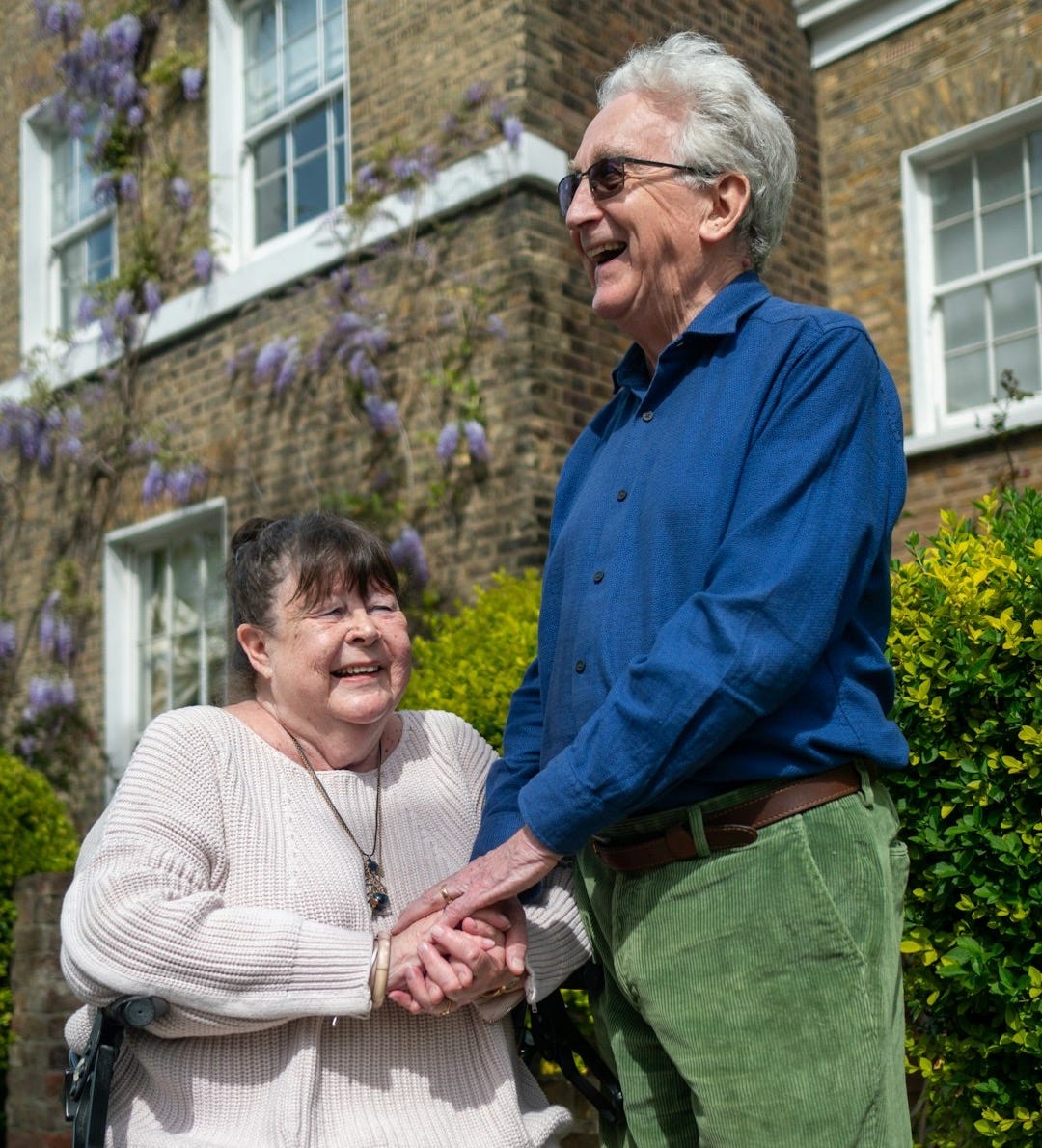
Settling in to their new home in assisted living was difficult for Dad. He told me “I’m the only sane person in here.”
One night, after they’d been there a few weeks, Mom fell out of bed. All Dad had to do was press a button and help would have come immediately. Instead he tried to pick her up, and created back problems that would take months to recover from.
Dad’s failure to accept the reality of their situation never really changed. At one point he got a mobility scooter, partly because of his back pain. He became a terror to the residents, moving as fast as he could. Several near misses occurred when he barreled around corners. He even knocked over a large clock that had to be repaired.
At one point Dad had to be hospitalized for an appendectomy. It was routine, with no complications. The night after the operation he called me at 3am from the hospital. He wanted me to call the police to report the theft of his mobility scooter, which of course was not there. I tried to explain that to him, but he hung up and made history by making the first-ever 911 call from inside the hospital.
Dementia and Alzheimer's often affect the personality of the sufferer. Some people become argumentative, even to the point of violence. Others may just become catatonic, oblivious to the world. Mom remained mostly the same, cheerful and friendly. The staff loved her, even as they avoided my father.
As her condition declined, Mom became a time traveler. My sister stopped being her daughter, and became a girlfriend. At one point she excitedly told my sister that her boyfriend was coming that day, and she thought he was going to ask her to marry him. The “boyfriend” was her husband of 60+ years.
The end arrived just short of two years after the move. Mom was transferred to hospice and passed not long afterward. I was awakened in the middle of the night, hearing her call my name. Of course this may have been a dream, but I like to think of it as a final goodbye.
My father lived on for another five years, still having most of his faculties, and unhappy with his surroundings. After all that the staff had put up with, my sister and I agreed to take the money remaining in his account and distribute it to the staff in appreciation of their kindness to both of them.
In going through the records and paperwork from our parents, a letter was discovered from the doctor that Mom had seen back in the early days before they moved to be near me. It explained quite clearly that the problems she was having were unrelated to thyroid medication dosage, and the doctor recommended that she be tested for Alzheimer's. Because of my father’s closest friend’s difficulties with a wife in care, I think Dad was unable to face the reality of a diagnosis. He did not get Mom tested. It’s possible that an earlier diagnosis might have helped her for a time, but the outcome would have been the same.
As people age, the progression from Mild Cognitive Impairment (MCI) to dementia and/or Alzheimer's has become increasingly common. The impact on a victim’s family is extremely stressful and expensive. If I’d known 20 years ago what I know now, I might have been able to better help my mother. Still I’m grateful that she finished her life reliving some of her happiest moments.
Having a mother with Alzheimer's increases my odds of having the disease by 80%. To avoid that outcome I have devoted a lot of time in improving my health. Most of my writing on this Substack has been about what I’ve learned and what I’ve done. Following a program of diet and exercise gives me the best chances of living a long life without burdening my family.
I am starting to notice pretty obvious signs in a family member but others in the family are in complete denial. I can see this path in our future, minus the multiple moves. My family member has flat out refuses to leave their home under ANY circumstances, has so far refused in home help as well. It’s not going to be an easy road. You talked about a trust and having it resolved- can I ask why? Also what instead was used in place? Thank you for sharing this difficult journey.
My grandmother on my mother's side had Alzheimer's. It was so hard watching her slip away. With how bad she got though, she always still called my mom "the baby" and me "the other baby". She had 3 other children, and she always would forget their names but not ours. I miss her terribly.